
Last updated November 16, 2026
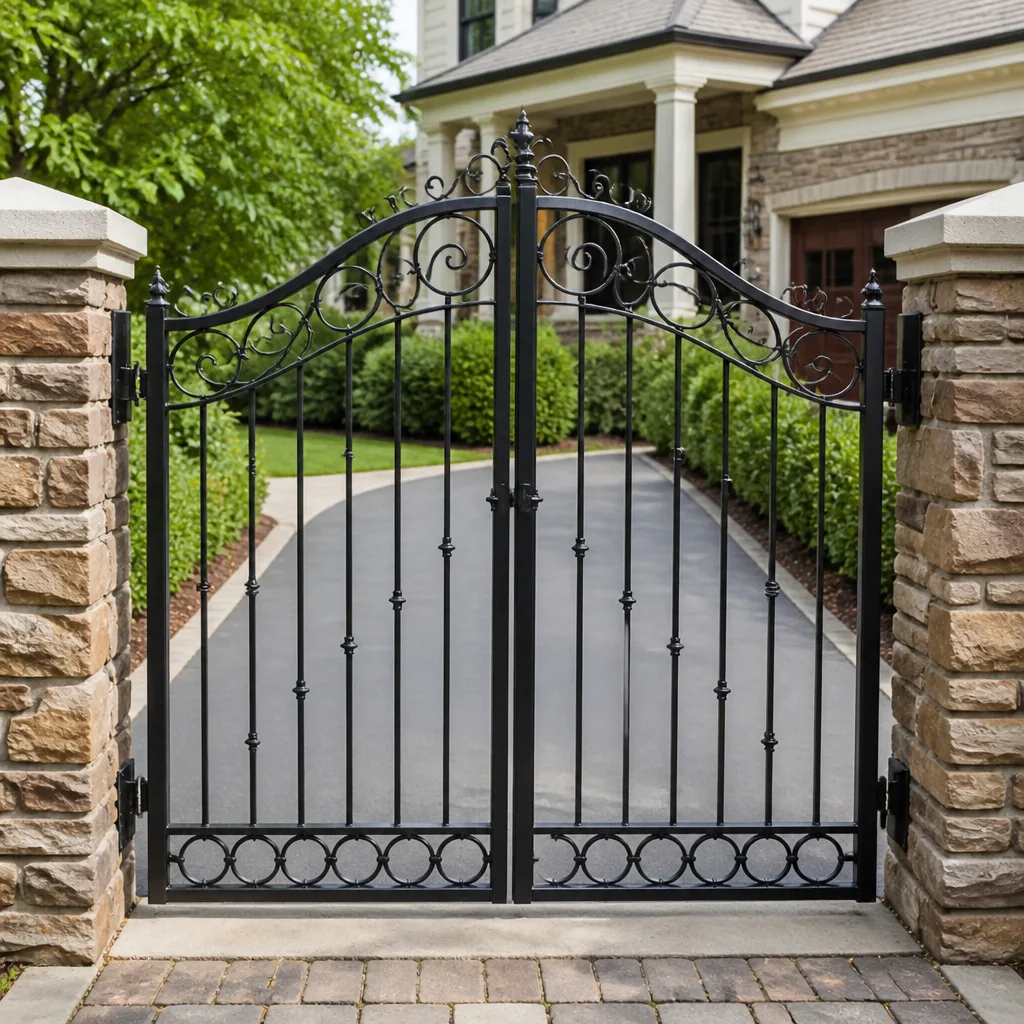 Wrought iron
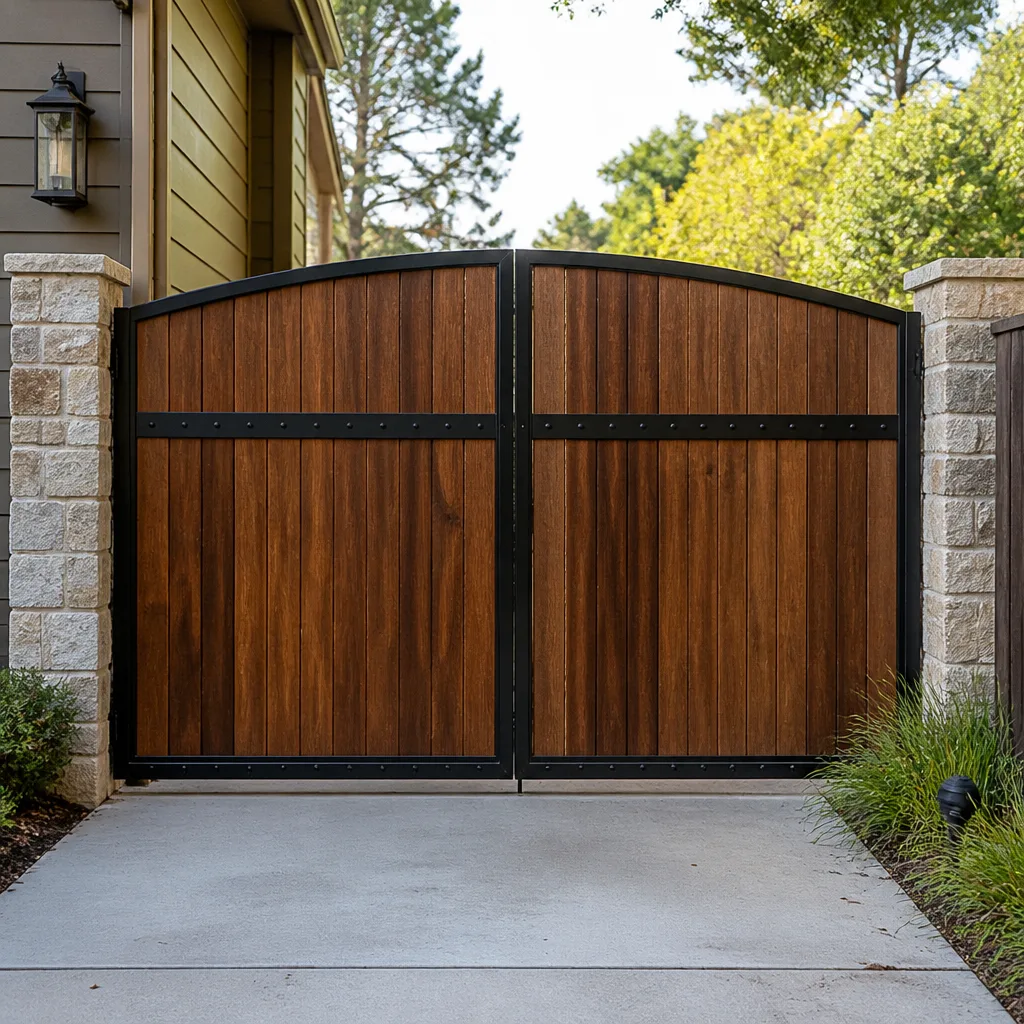 Wood & steel frame
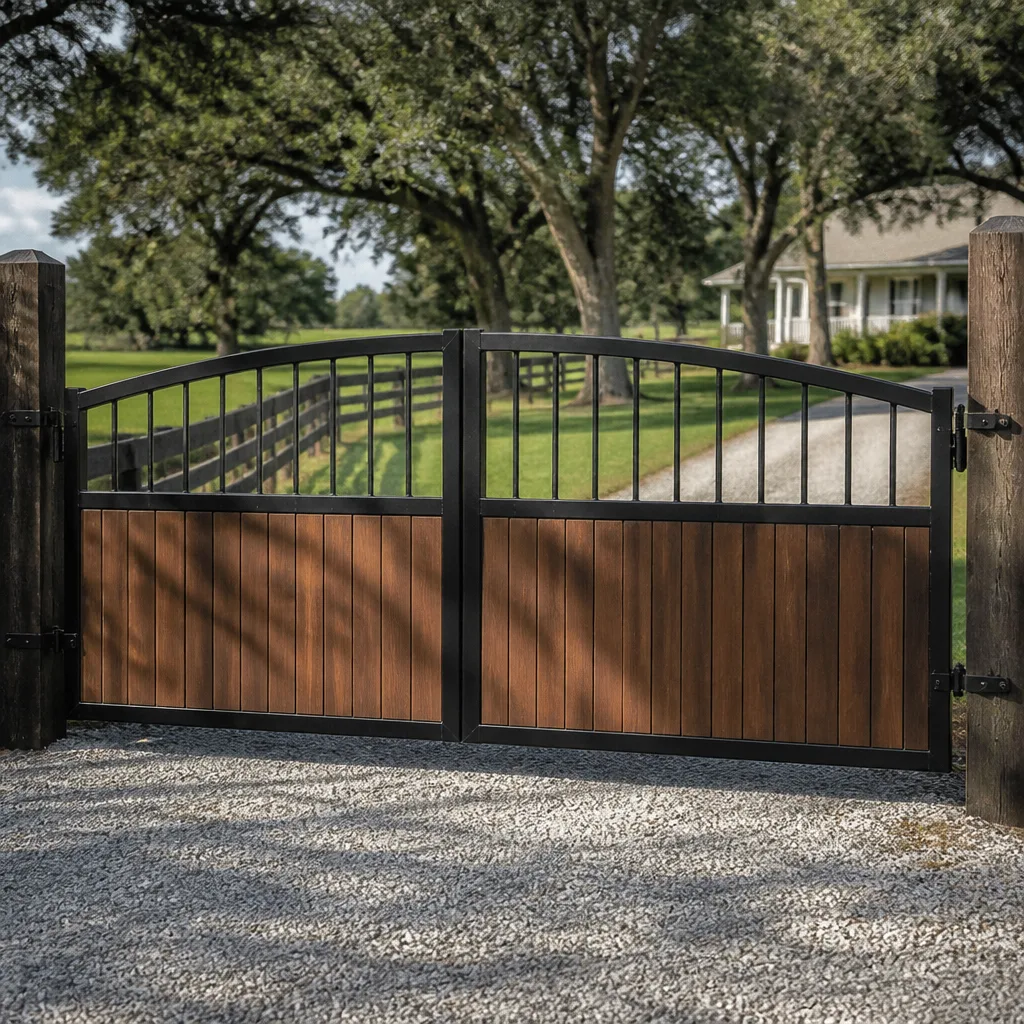 Farm & ranch
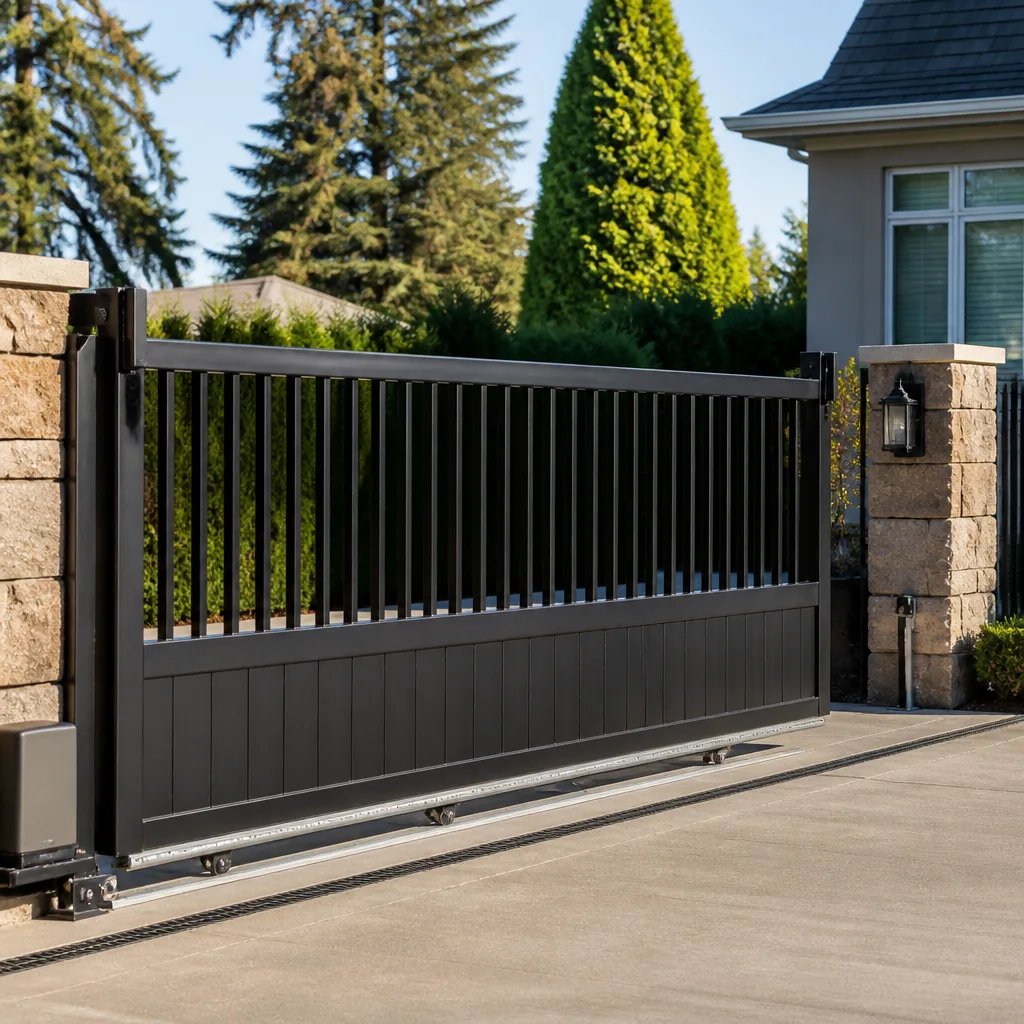 Sliding driveway gates
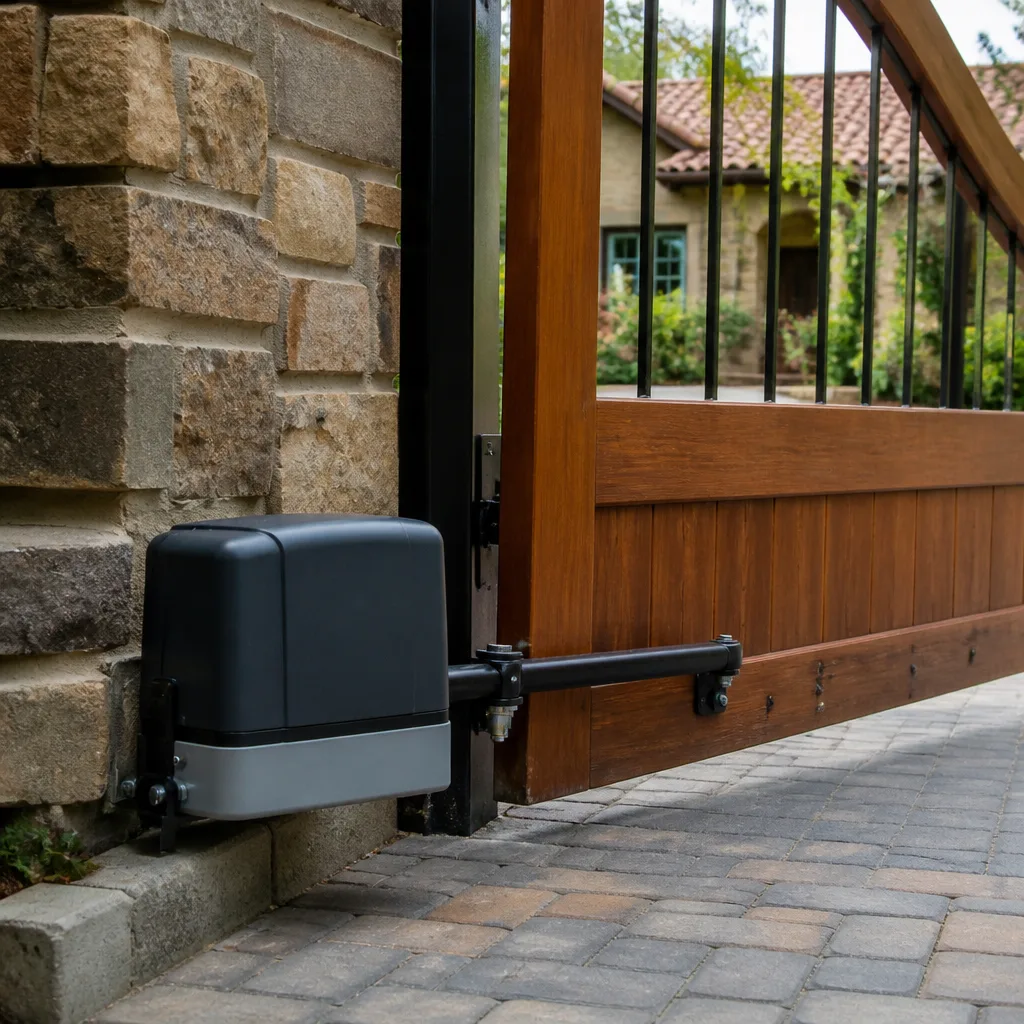 LiftMaster operators
Free on-site gate assessment - hinges, posts, and your LiftMaster or Nice gate operator checked before anything is quoted
The assessment is free and the quote is the invoice.
Get your free estimateGate Repair Emergency Preparedness Guide for Aurora Homes
Most gate emergencies in Aurora are not really about the gate. They’re about which direction it failed. A gate that jams open leaves your property exposed; a gate that locks shut traps cars, blocks caregivers, and strands family members in the cold. Homeowners tend to treat both the same way, which is a mistake. The two failures demand opposite responses, and forcing either one can turn a small repair into a structural job. This guide walks through manual release sequences for the operators we see most often in Aurora, how to secure a gate stuck open, what to tell a dispatcher so the right technician and parts arrive on the first visit, and the paperwork that saves time when something does go wrong.
Quick Answer
Aurora gate emergencies split into two categories: gates stuck open (a security problem, secured with temporary physical or electronic measures until a technician arrives) and gates stuck closed (an access problem, usually resolved with the correct manual release sequence for your operator brand). Never force a gate arm or slide panel by hand without first disengaging the operator’s release mechanism, because doing so can bend pivot brackets and turn a simple repair into a costly structural one. Know your operator model number and manual release procedure before you need them.
Styles & brands we work with
- Wrought iron
- Wood & steel frame
- Farm & ranch
- Sliding driveway gates
- LiftMaster operators
Table of Contents
- Fail-Open vs. Fail-Closed: Why Direction Changes Everything
- Manual Release Procedures by Operator Brand
- How to Secure a Gate Stuck in the Open Position
- What to Tell a Gate Repair Dispatcher in Aurora
- Pre-Emergency Documentation Every Aurora Home Should Keep
- Is an Emergency Call Worth It, or Can It Wait?
- Why Aurora Winters Stress Gate Operators
- When Emergency Repair Turns Into Replacement
Fail-Open vs. Fail-Closed: Why Direction Changes Everything
When a driveway gate stops responding to the remote, the first thing to determine is which direction it stopped in. This one observation determines whether you’re dealing with a security issue or an access issue, and the two require completely different priority responses.
A gate that fails open is a perimeter problem. The controller lost signal, a sensor tripped, or the motor stalled mid-travel, and the gate is sitting wide. Nothing is broken about your access, but your property is now exposed. The threat isn’t dramatic; it’s gradual. Doors get left unlocked because the gate was supposed to be watching, deliveries get misdelivered, and the whole function of the gate is suspended until it’s fixed.
A gate that fails closed is an access problem with a practical clock on it. If two cars are inside the gate and one needs to leave for work, you have hours, not days. If a family member is locked out in an Aurora winter, the situation moves faster than that. The immediate issue isn’t theft; it’s the inability to move people or vehicles through the one opening your property depends on.
This is why a “gate emergency” is not one thing. Before you call anyone, walk out and look at where the gate is. That single observation tells you whether the next step is securing the perimeter or establishing access. In our experience, most homeowners call with the wrong diagnosis still in hand, and starting with the direction saves a full round of questions on the call.
Manual Release Procedures by Operator Brand
Every automated gate operator has a manual release built in. It exists specifically so the gate can be operated by hand when power, motor, or controller fails. The release mechanism itself differs by brand, and using the wrong sequence is the fastest way to bend a bracket, strip a gear, or create a repair that costs several times what a basic service call would.
Below are the release sequences for the operator brands we work with most often in Aurora. The general rule across all of them: disengage first, then move the gate by hand. Never the other way around.
LiftMaster residential operators
- Locate the release mechanism on the operator body, usually a key-lock release or a manual bypass lever.
- Insert the release key and turn it fully, or pull the bypass lever down until it clicks into the released position.
- Slowly move the gate by hand to test that the arm is disengaged. If the arm still resists, the release did not fully engage; do not force it.
- Once the gate swings freely, prop or block it in the open position for access.
FAAC articulated arm operators
- Unlock the release cover with the supplied key, if the arm is equipped with one.
- Pull the release lever down and rotate it to the manual position.
- Test the arm by moving the gate a few inches by hand. The arm should now travel without resistance.
- If the arm binds after release, stop and call for service. A binding arm on a FAAC unit usually indicates a mechanical issue, not a controller fault.
Ghost Controls and Mighty Mule residential arms
- Most units in these families use a horizontal pull-release knob or lever on the top of the operator body.
- Pull the release knob fully outward until it stays out.
- Move the gate by hand to confirm release. The arm should trail loosely behind the gate.
- Push the knob back in once the gate is repositioned, so the operator is ready for the technician.
Apollo and heavy-duty slide operators
- Slide gates typically release via a clutch lever or a chain-hoist override on the operator housing.
- For clutch release: pull the lever fully and lock it in the manual position.
- For chain-hoist: check that the chain is intact before pulling; a broken chain means the gate must be moved by other means.
- A slide gate that comes off its track during manual operation is a safety issue; stop immediately and call for professional service.
One more point that applies to every brand: the dangerous parts of an automated gate are the operator’s wiring and power, the weight of the gate panel itself, and slide gates that jump the track. If any of these are involved, hand the job to a trained technician. We’re an electric gate repair specialist for exactly this reason; the electrical side is not a DIY job.
How to Secure a Gate Stuck in the Open Position
When your gate is stuck open, the priority is to close the physical gap until it can be repaired. There are two layers to that: physical and electronic. Use both if you can.
Physical measures
- Chain and padlock. If the gate has posts or pickets that can be chained, this is the fastest secure option. Run the chain through a fixed hinge side and around a post to prevent the gate from being swung open.
- Ratchet strap across the gate opening. A strap rated for the weight of the gate can hold panels together and reduce the visible gap. Not a permanent fix, but it discourages casual entry.
- Vehicle blocking. If the gate opens to a driveway and you have a second vehicle, park it across the opening. It’s crude, but it works until you can chain the gate or place a temporary brace.
- Temporary brace from behind. A cut piece of lumber wedged between the gate and its post on the closed side can hold panels in position. Never brace on the operator arm side; a jammed arm will damage the motor on the next cycle.
Electronic measures
- Disable the remote receivers. If your operator has a receiver kill switch or a lockout function, use it. This prevents anyone with a copied remote from cycling the gate further.
- Check your keypad codes. If the gate is stuck open but the keypad still cycles it, remove any shared or temporary codes before leaving the property overnight.
- Notify your alarm or camera system. If you have perimeter monitoring, tell the monitoring company the gate is compromised. Many will adjust their patrol or alert logic for a set period.
If your gate is stuck open and you’re heading out of town, this is the moment to call a technician rather than leaving the property exposed. A quick on-site visit can usually get the gate closed or establish a hard stop for the operator so it can’t cycle on its own.
What to Tell a Gate Repair Dispatcher in Aurora
The difference between a fast resolution and three technician visits is what you say on the phone. A gate specialist can dispatch the right person with the right parts if you give the right information. A generalist fence or handyman company will arrive without the parts and, in our experience, often can’t read the controller board anyway.
When you call for gate repair in Aurora, have these details ready:
- Operator brand and model number. LiftMaster, DoorKing, Elite, Ghost Controls, FAAC, BFT, Viking, Mighty Mule, and Linear are the nine brands we service. Naming the brand tells the dispatcher which technician has the right diagnostic experience.
- Direction of failure. Stuck open or stuck closed. This is the single most useful detail you can give.
- Gate type. Swing, slide, bifold, or barrier arm. Slide gates and swing gates have different safety systems and different failure modes.
- Whether the gate has power. Does the operator light come on? Does the remote make anything click? A dead operator with no lights is a power or board issue; a live operator that just sits there is likely a sensor or safety edge fault.
- Any recent events. A power bump, a storm, a car rolling through the beam, a code change. These narrow the diagnosis fast.
- Whether the gate is on a property with multiple units or shared access. Commercial and HOA properties need to be routed differently, especially if the closure affects an entire community entrance.
A dispatcher at a general contractor will hear “gate broken” and send a carpenter. A gate specialist hears the brand, the direction, and the operator light status and knows exactly which technician and which parts set to load. That’s why we tell Aurora homeowners to keep their operator model number written down; it saves an entire visit. Call Gate Repair Aurora when you need this level of triage.
Pre-Emergency Documentation Every Aurora Home Should Keep
The homeowners who get their gate back up and running fastest are not the ones with the most expensive hardware. They’re the ones with a single folder of documentation ready. Gate systems fail in the same places over and over, and each piece of documentation below removes one more step between “the gate is broken” and “the technician is on the way.”
- Operator model number and serial number. Stamped on the operator body or inside the control housing door. Photograph both and store them in your phone.
- Installer or last service contact. If you have a preferred gate company, keep their number in your phone contacts under “Gate”. If you don’t, keep a list of local gate specialists you’ve verified, not a general contractor.
- Manual release procedure photo. Take a photo of the release mechanism with an arrow pointing to the correct lever or key location. In a power outage at 11pm, you won’t remember which lever is which.
- Gate code backup. Your operator stores codes in the control board, but if the board fails, those codes are lost. Keep them written in a secure place and add new codes there as you add users.
- Wiring and low-voltage route notes. Which side of the driveway the power runs from, where the control box is mounted, and where the safety edge sensors are placed. This saves a technician from tracing the run during an emergency visit.
- Photos of the gate hinges, pivot brackets, and arm attachment points. If a bracket bends during a manual operation, an “before” photo tells the technician exactly what the geometry should look like.
A small zip-lock bag in a kitchen drawer with a printed copy of the above, plus a folder in your phone, covers both worlds. In Aurora, where the ground moves with seasonal freeze and thaw, gate geometry drifts too, so a periodic photo reference helps an Aurora technician identify when a gate has gradually slipped out of alignment rather than failed suddenly.
Is an Emergency Call Worth It, or Can It Wait?
The honest answer is that a lot of gate emergencies can be managed until the next regular dispatch day, and a few absolutely cannot. The dividing line is access, not time of day.
Manage it yourself until dispatch hours if:
- The gate is stuck open on a secure property with a physical chain holding it, and no one is inside the gate with a blocked exit.
- The gate is stuck closed but everyone has an alternative way in and out, and no family member is locked outside.
- The operator has lost power but the gate can be released and moved manually without resistance.
- The gate is only partially open or partially closed and can be blocked with a strap without stress on the operator arm.
Treat it as a genuine emergency if:
- Someone is locked outside the gate in cold weather.
- Someone inside needs access for health, medical, or caregiving reasons.
- A gate panel has come off its track, is hanging, or is fully blocked in a single exit.
- The gate has crashed into a vehicle, a person, or a fixed structure.
- The gate is stuck open with no way to chain, block, or secure it and the property is unattended.
We answer 24/7. A call outside dispatch hours is booked into the next opening, Sunday through Friday, 7am to 7pm. Fast dispatch from 7am to 7pm means a call placed in the morning gets the earliest possible visit that day. If you’re not sure whether your situation qualifies as urgent, call anyway. A short triage on the phone clarifies it: We answer 24/7, and we’ll tell you honestly whether waiting is safe or not.
Why Aurora Winters Stress Gate Operators
Aurora is a hard place on automated gates. Not because the gates are fragile, but because the combination of freeze-thaw ground movement and long stretches of sub-freezing mornings punishes every part of the system that relies on consistent geometry or a dry controller enclosure.
Four things break most often in the cold:
- Soil movement at the posts. When ground freeze lifts and settles the post anchors, the gate’s hinge alignment changes. A gate that swung freely in October can scrape the ground in January, and the operator tries to push through the resistance. That added load burns out motors and controllers over weeks.
- Frozen hinges and rollers. Moisture in the hinge pins or the slide gate rollers freezes overnight. The operator cycles with extra friction until something gives, and the first symptom is usually a loud motor strain or a short travel cycle.
- Ice on the track, safety edges, and photobeams. A slide gate’s track fills with ice, and the safety edge senses an obstacle it can’t clear. This is a false obstruction that stops the gate mid-travel and can leave it stuck open.
- Condensation in the control box. The temperature swing between a heated driveway and a cold night can create condensation inside an outdoor control enclosure. Boards fail slowly at first, causing intermittent faults that look like remote issues.
Our technicians have up to 9 years of experience with these specific operator failures, and each fall is when we see the most calls for gate repair Aurora as homeowners try one cycle in the first real freeze. If you’ve noticed your gate moving stiffly or making new noises in cold weather, that’s a pre-failure signal worth a service visit before the operator breaks a gear.
When Emergency Repair Turns Into Replacement
Not every gate emergency is repairably solved. Some failures are the operator aging out, and some are the gate structure itself reaching the point where repair is repeating a problem you’ve already had fixed. A gate specialist should tell you plainly which category you’re in.
Repair is usually the right call when:
- The operator is the failure point, not the gate geometry.
- A single board, receiver, motor, or safety edge has failed and the rest of the system is sound.
- The gate panel, hinges, and posts are structurally intact.
- The problem has a specific recent trigger (storm, power surge, damaged sensor).
Replacement starts to make sense when:
- The operator is a residential-grade unit on a cycle volume it was never built for. A DoorKing commercial operator belongs on a high-traffic community entrance; a residential arm belonging to the Ghost Controls or Mighty Mule family belongs on a single driveway. Mismatches produce recurring failures.
- Boards and motors have failed in the same system more than twice in a short window. Escalating repair costs on an older operator can exceed a replacement.
- The gate structure has warped, sagged, or had repeated hinge bracket failures. At that point, the operator is being asked to push a gate that no operator can push cleanly.
- You’re adding access control, intercom, or a higher cycle count. Sometimes the upgrade path is a new operator and not a repair.
We cover repair and full installation under the same service roster, so you don’t have to call a second company if the diagnosis lands on replacement. An Elite residential operator, a DoorKing high-cycle commercial unit, and everything in between fall inside our service range. Call (866) 361-5021 and the diagnostic visit tells you which side of this line you’re on.
Common Mistakes to Avoid
- Forcing the gate by hand without releasing the operator first. The single most expensive mistake we see. The operator arm stays engaged, the pivot bracket absorbs the force, and a simple release becomes a bent structural repair. Always disengage, then move.
- Assuming a gate stuck open is only an inconvenience. It leaves the property exposed for days if it isn’t chained or braced. Secure the opening first, then schedule the repair.
- Calling a fencing or handyman company for an operator fault. Fencing companies install gates; they don’t service control boards, receivers, and safety edges across multiple brands. A gate specialist is a different trade.
- Not knowing the operator model number. Without it, a technician arrives without the right parts and has to make a second visit. Photograph the model plate now, not after the gate fails.
- Ignoring cold-weather stiffness. With Aurora’s freeze-thaw cycles, a gate that gets stiff in January will eventually bind and burn out the motor. A pre-season service call is cheaper than a motor replacement.
- Two companies working the same gate. If an installer did the original work and a different company handles repair, get the documentation in one place. Duplicate code sets, mismatched safety edges, and incompatible receivers are frequent causes of intermittent failures.
- Leaving temporary restraints in place too long. A chain or strap holding a gate open is temporary. Left for weeks, it will warp the panel and hold the operator in an incorrect position while the system stays powered up.
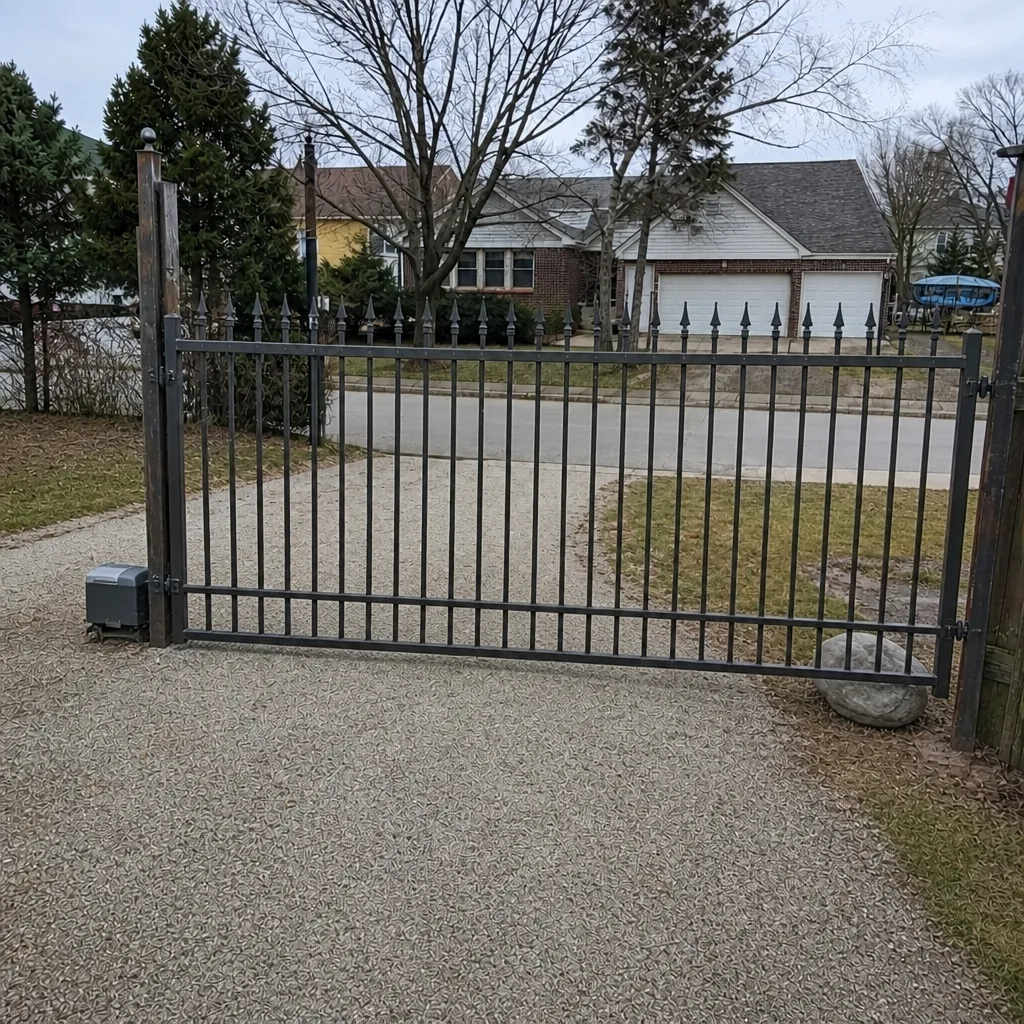
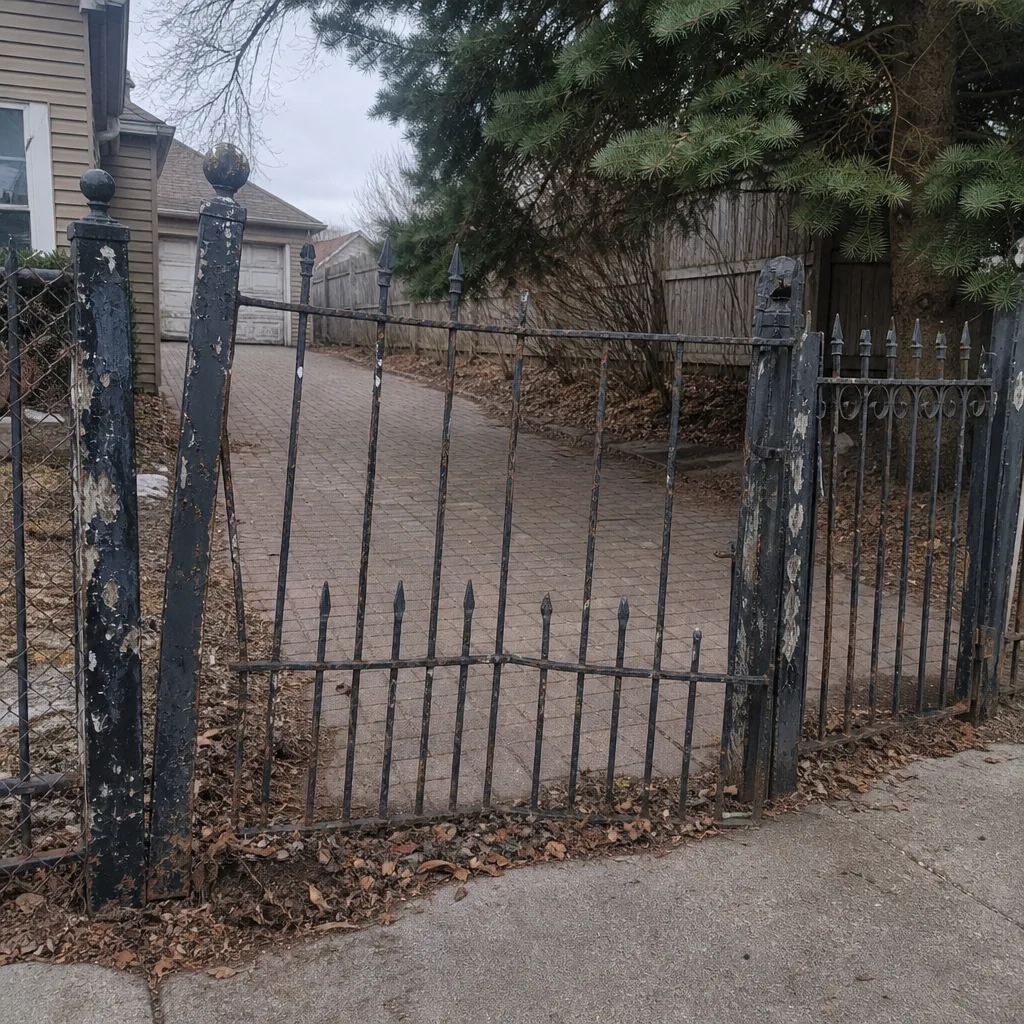
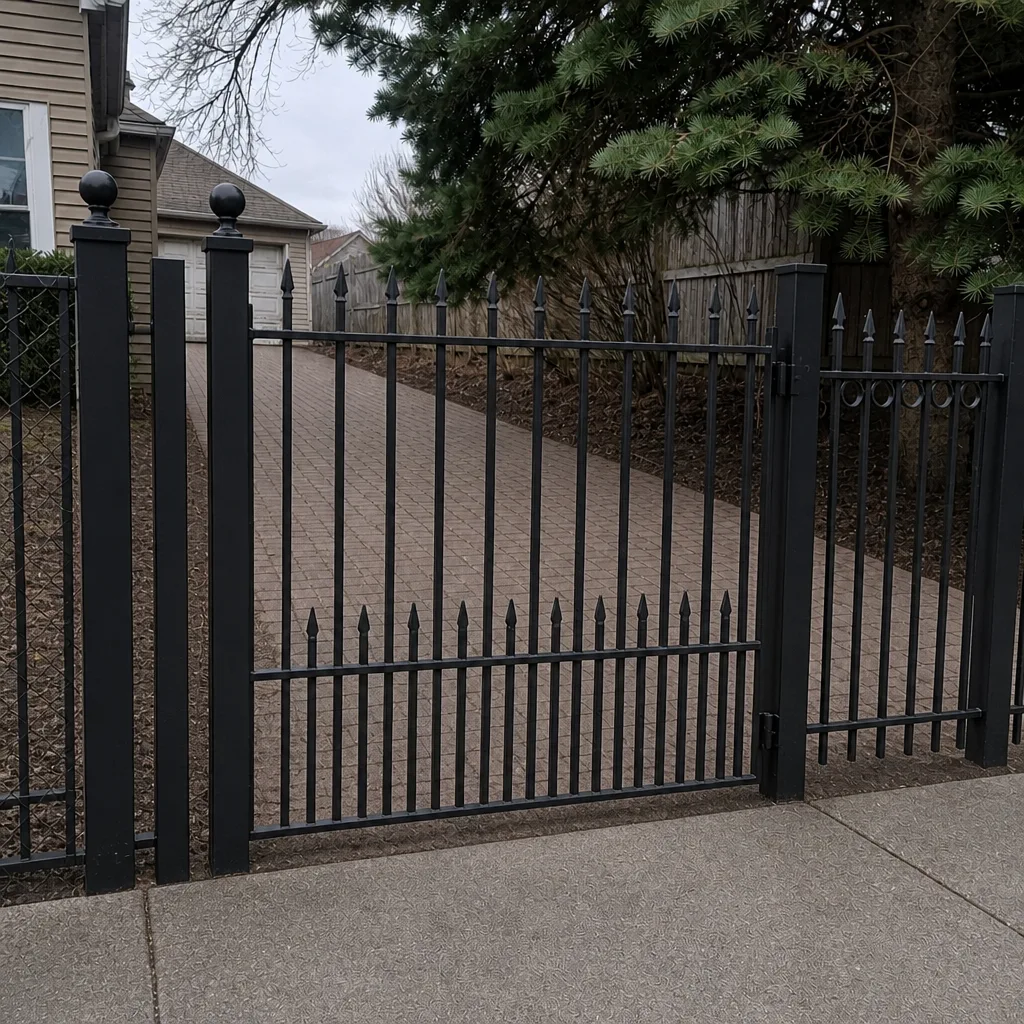
See the difference
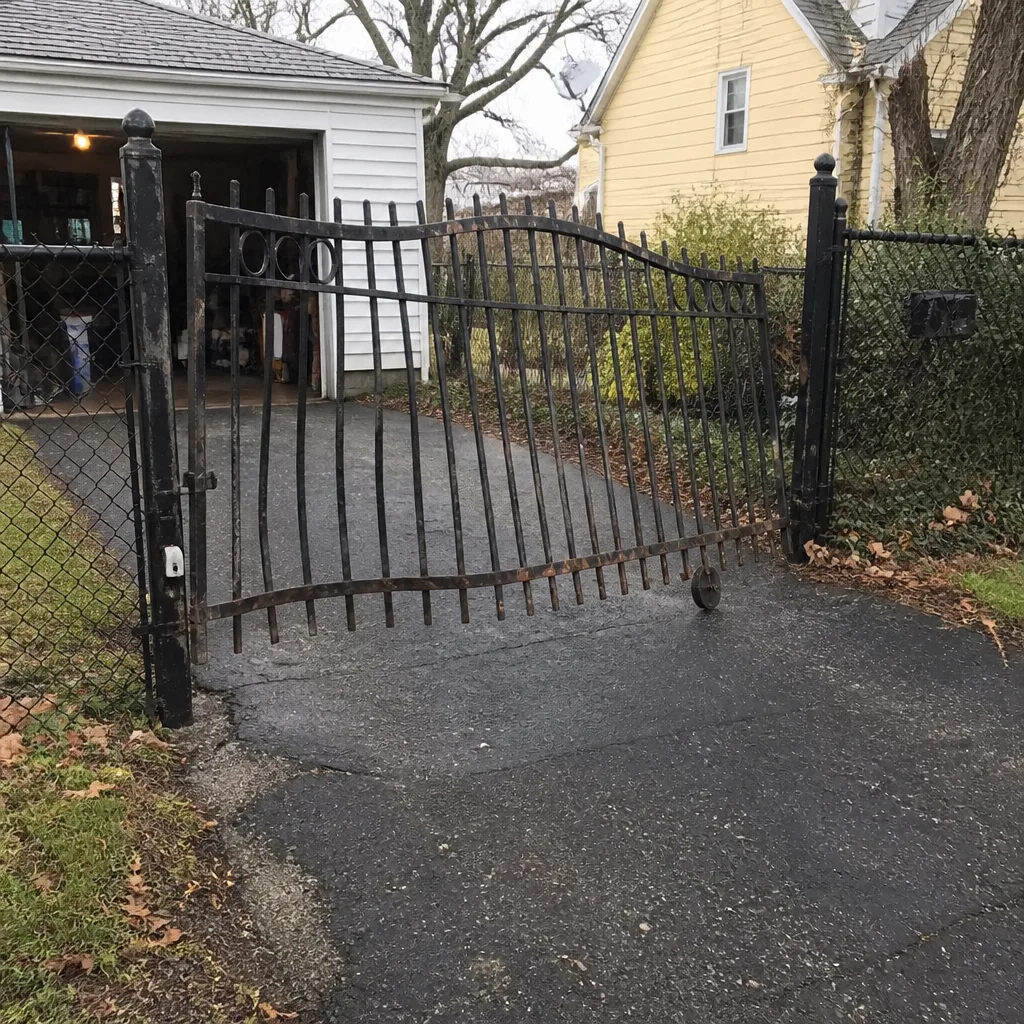 Before
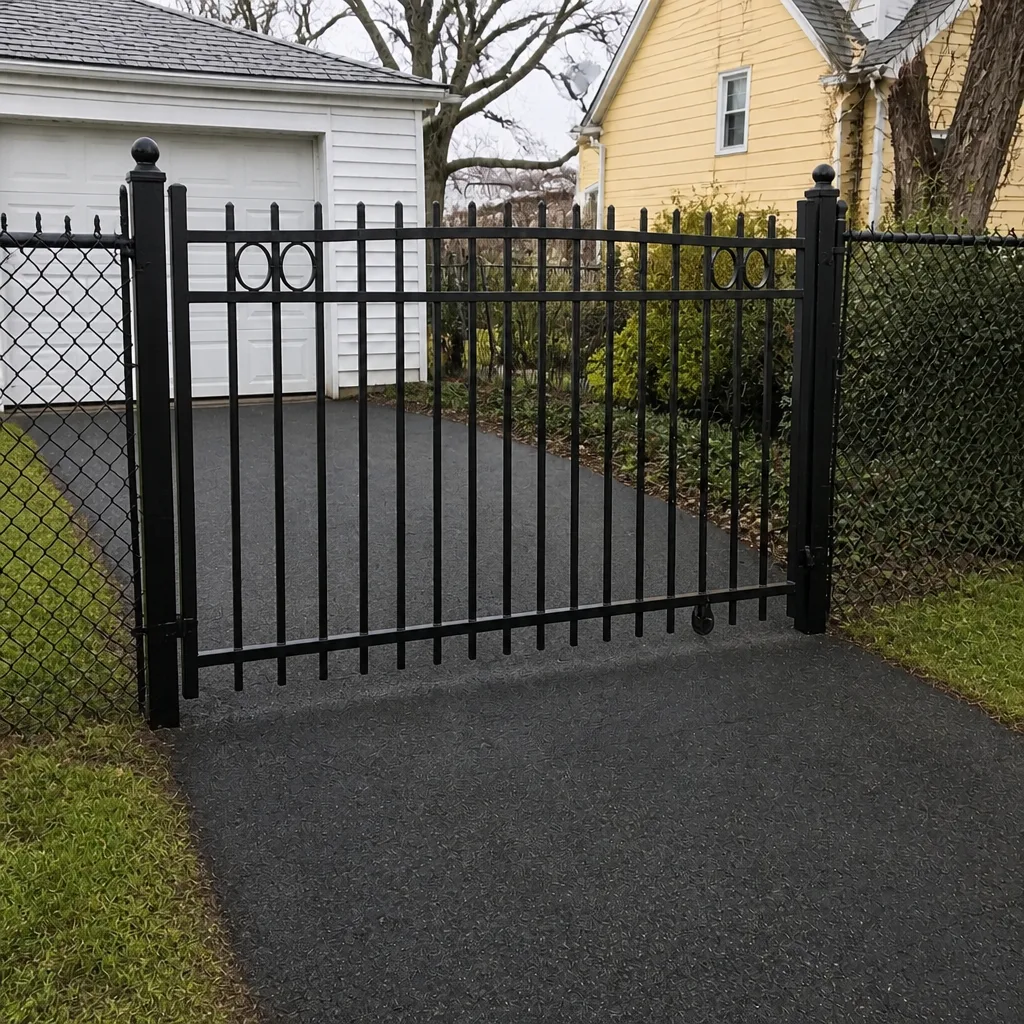 After
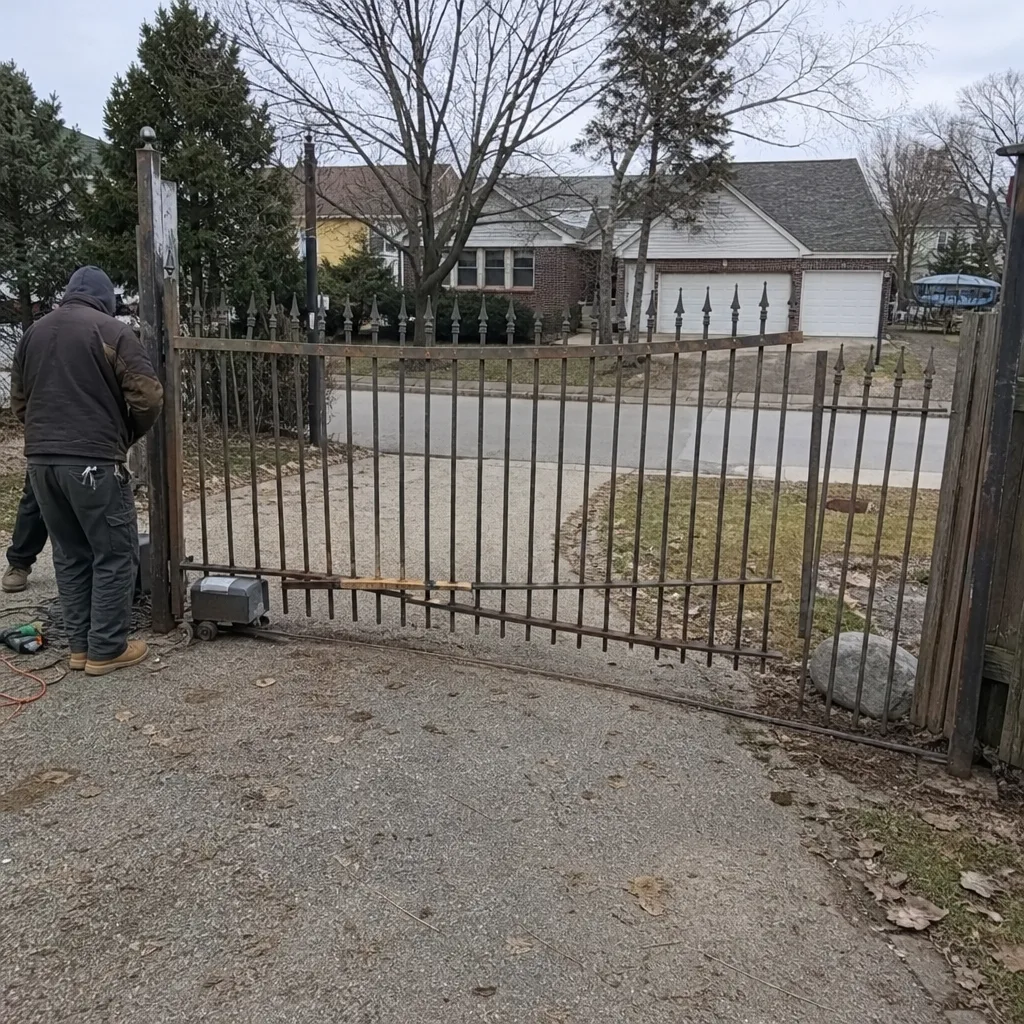 Before
 After
 Before
 After
When to Call a Professional
Call a gate specialist when the gate has failed in a way you can’t safely or fully secure with chains, straps, and a brace. Call immediately if the gate has come off its track, is hanging, has crashed into a vehicle or structure, or if someone inside is blocked from accessing medical or caregiving support. Call before forcing the gate by hand if you don’t know the manual release sequence for your specific operator. Call if the gate is cycling on its own, stopping mid-travel repeatedly, or making a sound it didn’t make last season; intermittent faults turn into board failures if left alone. Gate Repair Aurora offers free estimates in Aurora. Call (866) 361-5021. We answer 24/7. Fast dispatch from 7am to 7pm, Sunday through Friday.
Frequently Asked Questions
Locate the manual release on your operator and disengage it before moving the gate by hand. On LiftMaster operators this is a key-lock release or bypass lever; on FAAC units it is a release lever under a cover; on Ghost Controls and Mighty Mule arms it is usually a pull-knob on top of the operator; on Apollo slide operators it is a clutch lever or chain-hoist. Once released, the gate should move freely. If it still resists, stop and call for service; forcing it can bend the pivot bracket. Call (866) 361-5021 for an exact diagnosis.
It’s less urgent than a gate stuck closed, but it’s not low priority. The property is exposed, and the longer the gate stays open the higher the chance someone will interact with it and cause further damage. Chain or strap the gate closed, disable the remote receivers if possible, and schedule a repair visit. If you’re traveling or the property is unattended, book the repair before you leave rather than leaving the opening exposed.
Look on the operator body or the control housing door for a manufacturer plate with the brand name and model number. LiftMaster, FAAC, BFT, Linear, Viking, Ghost Controls, DoorKing, Elite, and Mighty Mule are the brands we service, and each has a different release sequence and control board layout. Photograph the plate. If you can’t find it, call (866) 361-5021 and a technician can usually identify the brand from a photo of the operator housing.
Always a gate specialist. General contractors and fencing companies install gates but typically don’t service the control boards, receivers, safety edges, or motor assemblies on automated operators. A specialist arrives with the right diagnostic experience for your brand on the first visit. Gate Repair Aurora handles electric gate repair specifically, not general fence or handyman work.
Often yes, if the gate is safely secured and no one is locked in or out. If yours is stuck open and chained, or stuck closed with alternative access for everyone on the property, waiting for the next dispatch window is reasonable. If someone is locked outside in cold weather, a caregiving or medical access is blocked, or a panel has come off its track, treat it as urgent and call. We answer 24/7. A call outside dispatch hours is booked into the next opening, Sunday through Friday, 7am to 7pm.
The price is set per job by a written estimate, and the estimate is free. We don’t quote over the phone without seeing the operator and gate, because a board fault, a safety edge fault, and a mechanical binding each take a different approach and different parts. Call (866) 361-5021 for a free estimate, and the written price you agree to before any work starts is the price you pay.
The Bottom Line
Gate emergencies split by direction, and the wrong first move is expensive. Fail-open means secure the opening with chains, straps, or a vehicle. Fail-closed means manual release first, then move by hand, never the other way. Know your operator brand number, know the release sequence, and keep the documentation where you can find it in the dark. Aurora winters stress the whole system: post movement, frozen hinges, iced safety edges, and cold-faulty boards. Handle the small stiffness before it becomes a motor failure. If you’re unsure, call and get triaged. Gate Repair Aurora offers free estimates, upfront pricing, and a written quote before work begins. Call (866) 361-5021. We answer 24/7. Fast dispatch from 7am to 7pm, Sunday through Friday.
Written by the team at Gate Repair Aurora.